Modern education is changing the way students learn, understand information, and solve problems. In the past, education often focused mainly on memorizing facts and repeating information during exams. Today, schools and colleges are giving more attention to understanding concepts, asking questions, analyzing information, and developing independent opinions. This change has made critical thinking an important part of modern education.
Critical thinking helps students look at information carefully before accepting it as true. It teaches them how to ask meaningful questions, compare different ideas, identify reliable information, and make decisions based on evidence. In a world where students have access to a huge amount of information through the internet and digital technology, these skills are more important than ever.
What Is Critical Thinking in Education
Critical thinking is the ability to examine information logically and make a thoughtful judgment. It does not mean that students should disagree with everything they hear. Instead, it means they should understand an idea, consider different viewpoints, check evidence, and then reach a reasonable conclusion.
In education, critical thinking encourages students to move beyond simple memorization. Instead of only asking students to remember an answer, teachers can ask why an answer is correct and how students reached their conclusion. This approach helps learners develop deeper understanding and become more confident in their own thinking.
Critical thinking also helps students recognize mistakes in their reasoning. When students learn to question their assumptions and consider other possibilities, they become better problem solvers both inside and outside the classroom.
Modern Teaching Methods Promote Independent Thinking
One major way modern education encourages critical thinking is through new teaching methods. Traditional teaching often places the teacher at the center of the classroom, while modern education gives students a more active role in learning.
Student centered learning allows learners to participate in discussions, activities, research, and problem solving. Students are encouraged to share their ideas instead of simply listening to a teacher. This creates an environment where they can develop their own opinions and learn from the opinions of others.
Teachers can also use open ended questions that do not always have one simple answer. Such questions encourage students to explain their reasoning and support their opinions with evidence. This makes classroom learning more active and meaningful.
Classroom Discussions Build Critical Thinking Skills
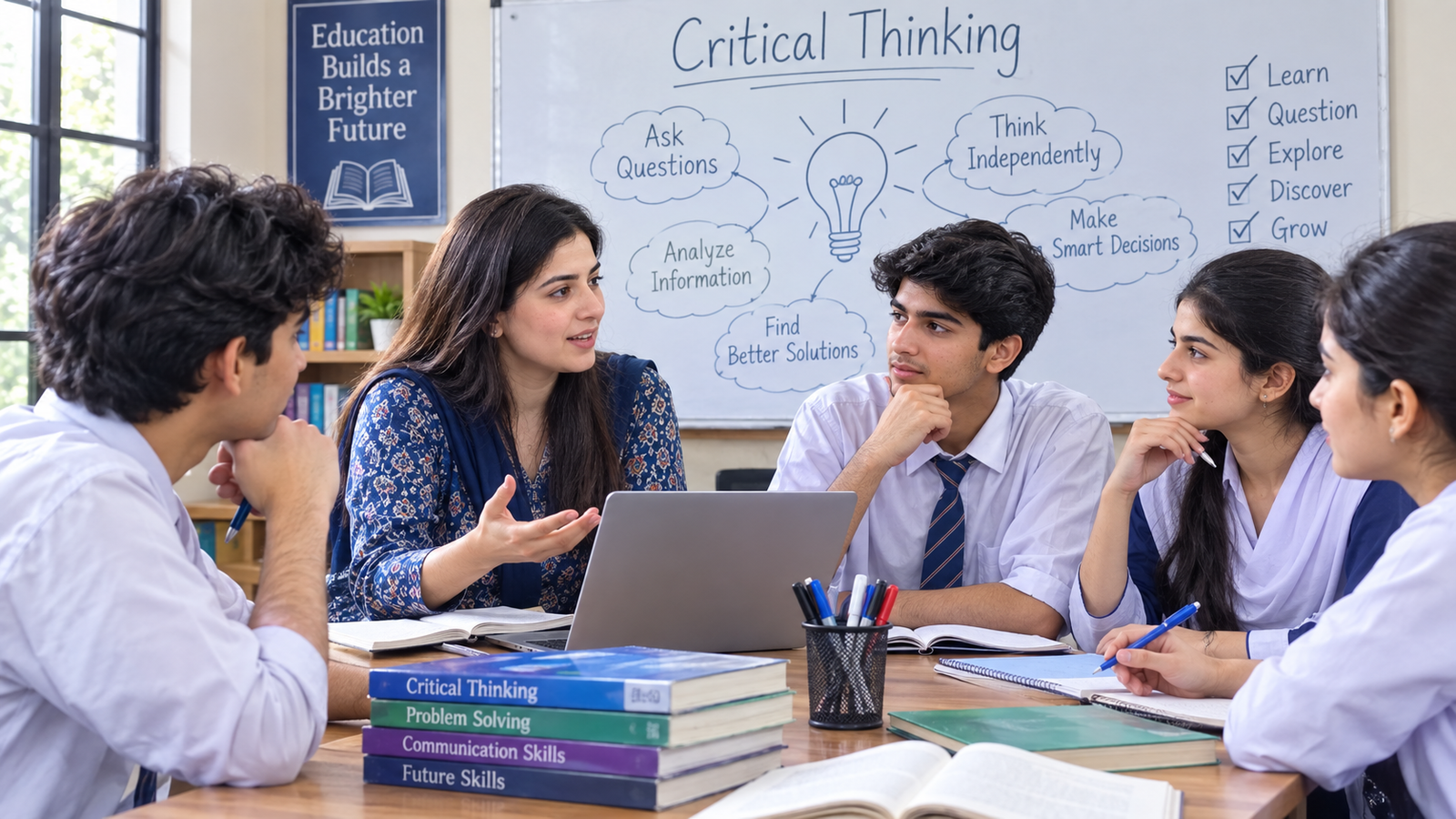
Classroom discussions are another important part of modern education. When students discuss a topic with their classmates, they hear different opinions and perspectives. They learn that people can understand the same issue in different ways.
A good classroom discussion encourages students to explain why they believe something. They may need to provide examples, facts, or evidence to support their ideas. At the same time, they learn how to listen respectfully when someone has a different opinion.
This process develops communication skills as well as critical thinking. Students learn that changing their opinion after considering new evidence is not a weakness. Instead, it can be a sign of good reasoning and intellectual growth.
Project Based Learning Encourages Problem Solving
Project based learning is widely used in modern education because it gives students opportunities to solve practical problems. Instead of completing only traditional exercises, students may work on projects that require research, planning, creativity, and decision making.
For example, students may be asked to develop a simple business idea, investigate an environmental problem, or create a solution for a problem in their community. During the project, they must decide which information is useful and which approach is most effective.
This type of learning naturally develops critical thinking. Students have to evaluate options, identify problems, make decisions, and sometimes change their plans when something does not work. These experiences prepare students for real life situations where problems rarely have one perfect answer.
Technology Gives Students Access to More Information
Technology has transformed modern education by giving students access to enormous amounts of information. Students can use online libraries, educational websites, digital books, videos, research papers, and learning platforms to explore different subjects.
However, having access to information does not automatically mean that students know how to use it correctly. The internet also contains incorrect, outdated, biased, and misleading information. This makes information literacy an important part of critical thinking.
Modern education teaches students to question online information and check where it comes from. They can learn how to compare different sources, identify trustworthy websites, examine evidence, and recognize misleading claims.
These skills are especially important because students encounter information every day through search engines, social media, websites, and digital platforms.
Teachers Act as Guides in Modern Education
The role of the teacher is also changing. Teachers are no longer only expected to provide information. They increasingly act as guides who help students discover information and develop their own understanding.
A teacher can present a problem and allow students to explore possible solutions. Instead of immediately giving the correct answer, the teacher can ask questions that encourage students to think more deeply.
For example, if students are studying an environmental issue, the teacher can ask what caused the problem, who is affected, what evidence supports different opinions, and what solutions might be possible. This approach encourages students to analyze a situation from multiple perspectives.
Problem Solving Develops Better Reasoning
Modern education places strong importance on problem solving because real life requires people to make decisions in uncertain situations. Students need to know how to understand a problem, identify possible solutions, evaluate those solutions, and choose the most suitable option.
Problem solving activities can be used in almost every subject. Mathematics can teach logical reasoning, science can encourage investigation, history can require students to examine evidence, and language subjects can help students analyze arguments and ideas.
When students regularly practice solving problems, they become more comfortable with challenging situations. They learn that making a mistake is part of the learning process and that problems can often be approached in several different ways.
Debate and Group Activities Improve Analytical Skills
Debates are another effective method for developing critical thinking in education. During a debate, students must understand an issue, research evidence, prepare arguments, and respond to opposing viewpoints.
Students cannot simply repeat information. They need to understand their topic well enough to explain and defend their position. They also need to listen carefully to the other side and identify weaknesses or strong points in different arguments.
Group activities can provide similar benefits. When students work together, they have to divide responsibilities, discuss ideas, solve disagreements, and make decisions. These experiences improve reasoning, communication, cooperation, and leadership skills.
Modern Assessment Focuses on Understanding
Assessment methods are also changing in modern education. Traditional exams often focus heavily on remembering information. Modern assessment can include presentations, research projects, case studies, practical activities, portfolios, and problem solving tasks.
These methods allow teachers to evaluate whether students truly understand a subject. A student may be asked to explain a concept in their own words, analyze a situation, or suggest a solution to a particular problem.
Such assessments encourage students to think instead of simply memorizing answers. They also help teachers identify areas where students need additional support.
Critical Thinking Prepares Students for Future Careers
Critical thinking is not only useful for academic success. It is also an important skill for future careers. Employers need people who can analyze situations, solve problems, make responsible decisions, and adapt to change.
Modern workplaces often involve complex challenges that cannot be solved by following a fixed set of instructions. Employees may need to evaluate information, understand customer needs, identify risks, and develop new ideas.
Students who develop strong critical thinking skills are better prepared for these challenges. They can approach problems with confidence and make decisions based on evidence rather than assumptions.
Critical Thinking Helps Students Become Responsible Citizens
Education also has a wider purpose than preparing students for employment. It helps them become responsible members of society. Critical thinking allows people to understand social issues, evaluate public information, and make informed decisions.
Students who know how to examine evidence are less likely to accept every claim they encounter. They can consider different viewpoints and form opinions based on reliable information.
This is especially valuable in the digital age, where misinformation can spread quickly. Critical thinking gives young people the tools they need to navigate information responsibly.
Conclusion
Modern education encourages critical thinking by moving students beyond memorization and passive learning. Student centered learning, classroom discussions, project based learning, technology, debates, group activities, problem solving, and modern assessment methods all give learners opportunities to think independently.
Critical thinking helps students understand information, question assumptions, evaluate evidence, solve problems, and make better decisions. It also prepares them for future careers and everyday life.
The goal of modern education is not simply to give students more information. It is to teach them how to understand and use that information wisely. When schools create classrooms where students can ask questions, explore ideas, make mistakes, discuss different viewpoints, and find solutions, they help develop confident and independent thinkers.
For this reason, critical thinking should remain a central part of modern education. It gives students valuable skills that can support academic achievement, career development, personal growth, and responsible participation in society.