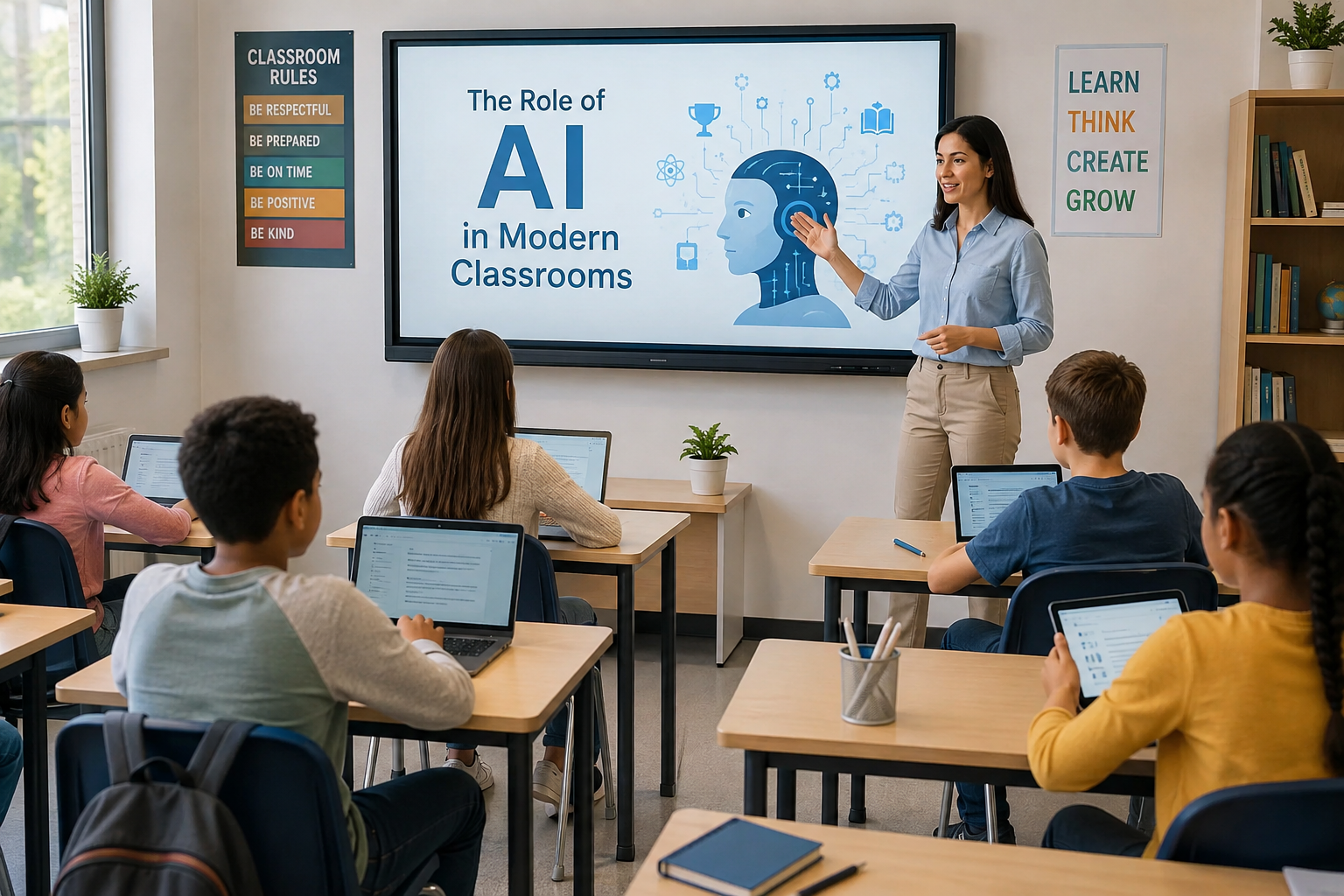
Artificial Intelligence is becoming an important part of modern education. From smart learning platforms to personalized study tools, artificial intelligence is changing the way students learn and teachers teach. Modern classrooms are no longer limited to textbooks, notebooks, and traditional lectures. Technology now gives teachers and students new ways to understand information, practice skills, communicate, and solve problems.
The role of artificial intelligence in modern classrooms is especially important because every student learns differently. Some students understand a topic quickly, while others need more explanation and practice. Artificial intelligence can help create a learning environment where students receive support according to their individual needs. It can also help teachers save time and focus more on teaching, communication, and student development.
What Is Artificial Intelligence in Education?
Artificial intelligence in education means using computer systems and smart technologies to support teaching and learning. These systems can process information, identify patterns, answer questions, provide feedback, and recommend learning materials.
In modern classrooms, artificial intelligence can appear in many forms. Students may use intelligent learning applications to practice mathematics, improve writing, learn languages, or understand difficult scientific concepts. Teachers can use AI based tools to prepare lessons, create quizzes, organize learning materials, and understand student progress.
The main purpose of artificial intelligence in education should not be to replace teachers. Instead, it should support teachers and make learning more effective, flexible, and engaging.
Personalized Learning for Students
One of the biggest benefits of artificial intelligence in modern classrooms is personalized learning. Traditional classrooms often use the same lesson and activities for all students. However, students have different abilities, interests, learning speeds, and educational needs.
AI powered learning systems can analyze student performance and identify areas where a student is doing well or struggling. Based on this information, the system can recommend additional practice or easier explanations. A student who understands a lesson quickly can move toward more challenging activities, while another student can receive additional support.
Personalized learning can help students become more confident because they can study at a pace that is comfortable for them. It also gives teachers useful information about individual learning needs.
AI Helps Teachers Save Time
Teachers have many responsibilities outside classroom teaching. They prepare lessons, create assignments, check work, provide feedback, record student progress, and communicate with parents. Artificial intelligence can reduce some of these time consuming tasks.
AI tools can help teachers create questions, lesson ideas, practice exercises, and educational activities. Some systems can also assist with grading certain types of assignments and organizing student information.
When teachers spend less time on repetitive administrative work, they can spend more time interacting with students. Personal communication between teachers and students remains one of the most important parts of successful education.
Improving Student Engagement
Keeping students interested in learning can sometimes be difficult. Long lectures and repetitive activities may cause students to lose attention. Artificial intelligence can make learning more interactive by providing activities that respond to student actions.
AI powered educational platforms can include quizzes, simulations, virtual learning environments, language practice, and interactive exercises. Students can receive immediate feedback instead of waiting until the teacher checks their work.
This quick feedback can make learning more active. Students can understand their mistakes and try again while the topic is still fresh in their minds. Interactive learning also gives students more opportunities to participate instead of simply listening to information.
Artificial Intelligence and Learning Support
Students sometimes hesitate to ask questions in front of their classmates. An AI learning assistant can provide another way for students to ask questions and receive explanations.
For example, a student who does not understand a mathematical problem can ask an AI system for a simpler explanation. A student learning English can use an AI tool to practice vocabulary and sentence structure. A science student can ask for an explanation of a difficult concept using simple language.
However, students should learn to use AI as a learning support tool rather than depending on it for every answer. The goal should be to help students understand concepts and develop their own skills.
Supporting Different Learning Styles
Every classroom contains students with different preferences and abilities. Some students learn better through reading, while others understand concepts through visual examples, practice, discussion, or demonstrations.
Artificial intelligence can support different learning approaches by providing information in different formats. A difficult concept can be explained using simple text, examples, questions, or interactive activities.
This flexibility can make education more accessible to a wider range of learners. Teachers can also use AI suggestions to create different activities for students who need additional support or additional challenges.
Helping Teachers Understand Student Progress
Understanding student progress is important for improving classroom performance. Traditional assessment methods may not always provide enough information about how students are learning.
AI systems can analyze student responses and identify common mistakes or areas of weakness. Teachers can use this information to decide which topics need additional explanation.
For example, if many students perform poorly on the same topic, the teacher may realize that the concept needs to be taught again using a different method. This can help teachers make better decisions based on actual student performance.
AI Can Encourage Independent Learning
Modern education should help students become independent learners. Students need to know how to find information, ask questions, solve problems, and improve their knowledge without always depending on a teacher.
Artificial intelligence can support independent learning by giving students access to educational resources when they need them. Students can practice outside school hours and explore topics that interest them.
This can be particularly useful for students who want to study beyond the classroom curriculum. AI can help them discover explanations, examples, exercises, and learning resources related to their interests.
Developing Critical Thinking Skills
Although artificial intelligence can provide information quickly, students still need critical thinking skills. They must learn that not every AI generated answer is automatically correct.
Teachers can use AI as an opportunity to teach students how to check information, compare sources, identify mistakes, and form their own conclusions. Instead of simply accepting an answer, students should ask whether the information is accurate and whether there is evidence to support it.
This approach can make artificial intelligence a useful tool for developing digital literacy and critical thinking. Students learn not only how to use technology but also how to use it responsibly.
Challenges of Artificial Intelligence in Classrooms
Artificial intelligence has many benefits, but it also creates challenges. One major concern is student dependence on technology. If students use AI to complete every assignment without thinking, they may fail to develop important skills.
Privacy is another important issue. Educational systems may collect information about student performance and learning behavior. Schools need to make sure that student information is handled carefully and responsibly.
Teachers also need proper training. Simply giving teachers access to AI tools does not guarantee effective use. Teachers should understand how these systems work, what their limitations are, and how they can be used to support genuine learning.
Another challenge is unequal access to technology. Not every student has the same access to computers, smartphones, or reliable internet connections. Schools need to consider this digital gap when introducing AI into education.
The Future of AI in Modern Education
The future of artificial intelligence in modern classrooms is likely to become more advanced. AI tools may provide more personalized learning experiences, better feedback, improved educational resources, and stronger support for teachers.
However, technology should remain a tool rather than the center of education. Teachers provide motivation, emotional support, guidance, creativity, and human understanding that technology cannot fully replace.
The most effective classrooms will likely combine artificial intelligence with strong teacher involvement. AI can handle certain repetitive tasks and provide useful information, while teachers can focus on helping students think, communicate, collaborate, and grow.
Conclusion
The role of artificial intelligence in modern classrooms is growing rapidly. AI can support personalized learning, improve student engagement, save teachers time, provide learning assistance, and help schools understand student progress. It can also encourage independent learning and create opportunities for students to develop digital and critical thinking skills.
At the same time, artificial intelligence should be used carefully. Students need to understand that AI is a tool for learning, not a replacement for their own thinking and effort. Teachers need proper training, schools need responsible technology policies, and students need guidance about using AI ethically.
When used in the right way, artificial intelligence can become a valuable part of modern education. It can help create classrooms where learning is more personalized, interactive, accessible, and effective. The future of education will not simply be about using more technology. It will be about using technology wisely to give teachers and students better opportunities to learn and succeed.